
TLDR: No.
On August 25th, I finished my analysis on whether a third party could win a Council At Large seat. I was surprised at how hard it would be for any of them to reach the ~35K votes necessary to win a seat. A candidate would have to perform twice as well as the best third party candidate in recent history, Andrew Stober. This would mean taking how he did in his single best division, and performing that well on average across Center City, its wealthy progressive ring, and the Northwest. It seemed unrealistic.
The day after I published my piece, Helen Gym endorsed Kendra Brooks of the Working Families Party. Then the October filings showed that Brooks had nearly doubled the donations of the highest GOP fundraiser. She’s generated a buzz that makes it seem like maybe, just maybe, the impossible could happen. We’re officially in outlier territory, and analyses of historical data have a hard time with outliers.
She’s generated so much buzz, in fact, that some Philadelphians are apparently wondering if one of the Democrats could lose? Could Brooks and her WFP co-candidate O’Rourke split the vote, siphoning off enough votes that one of the five Democrats loses a seat?
No. That is not going to happen.
There are three reasons this isn’t even a remote possibility:
Democrats’ dominance means that they would need to lose more than 55% of their votes to lose the seat.
A Democrat losing would require three candidates doing impossibly well, not just two.
The existence of echo chambers means the surge isn’t as large as you think.
This piece largely uses the same analyses I wrote about in August (so no code). But instead of asking whether a third party could win, let’s ask if a Democrat could lose.
Democrats’ dominance of recent elections
Democrats more than doubled the votes of the top vote-getting Republican in 2011. Then they more than tripled it in 2015. 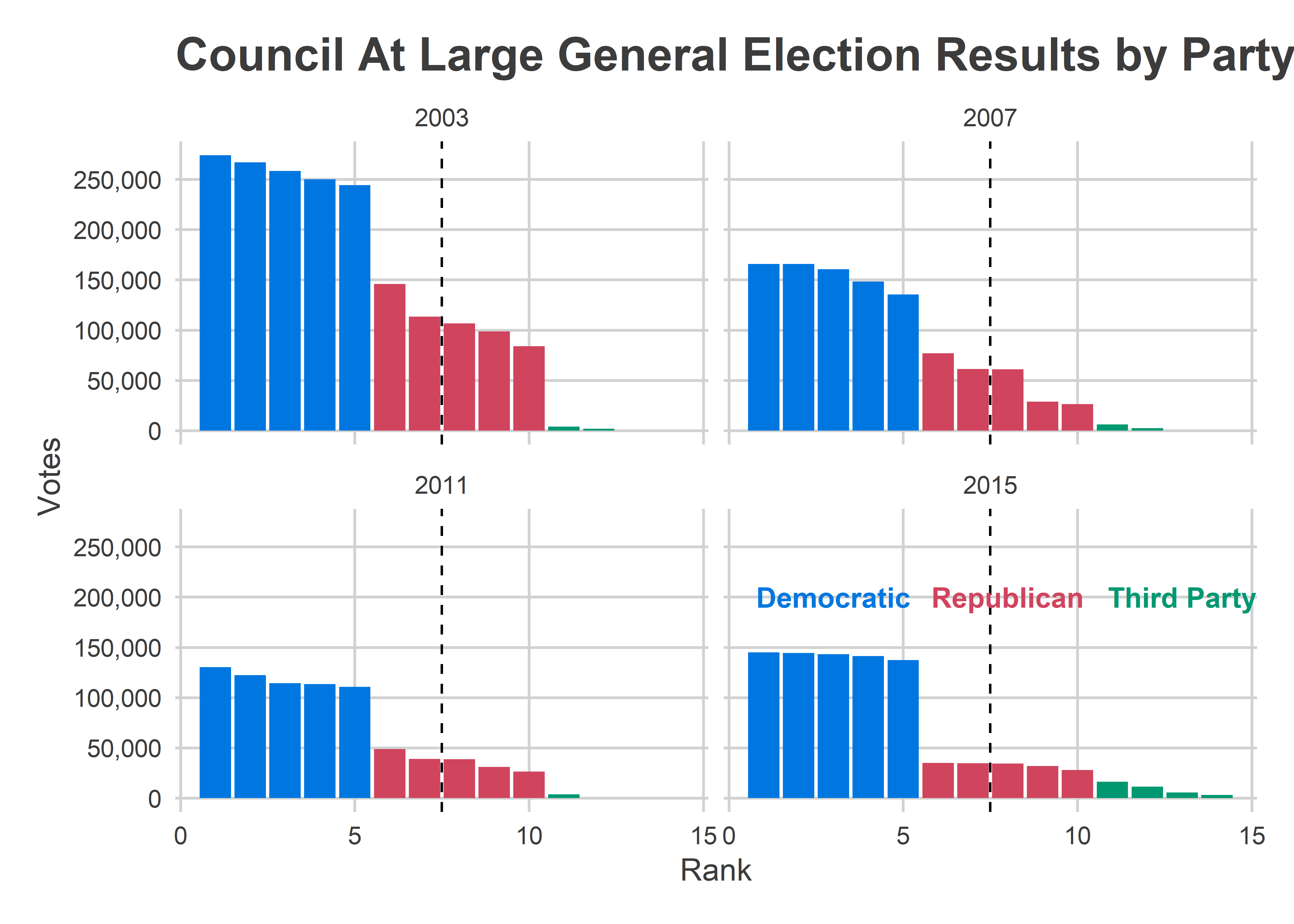
The scale of plausible votes for Brooks wouldn’t even dent that margin. The best showing of a third party candidate was 2015’s Andrew Stober, who received 16,301 votes. That was less than half of the 34,711 received by Al Taubenberger, the 7th and final At Large winner.
The gap between Democrats and that third Republican is more than double that. Consider 2011, since 2015 showed even more Democratic dominance than usual. In 2011, Greenlee was the fifth Democrat in with 110,544 votes. The seventh place vote-getter was David Oh, with 38,835.
Now, suppose Kendra Brooks time travels back to 2011 and runs for Council At Large. In order for Greenlee to lose to Oh, he would need to lose 70,000 votes. That would mean (a) Brooks would have to win those 70,000 votes, more than four times what Stober did in 2015, and (b) that every single one of those votes would need to come from Greenlee, instead of any of the other four Democrats. More realistically, Brooks’ voters would probably cast their other votes for a handful of the Democrats, so that a fraction of her votes were cannibalized from each of the candidates. And even if Brooks’ voters all bullet voted for her (ignoring my not-yet-written advice against it), it would take 70,000 bullet voters to make Greenlee lose.
It would take three strong insurgents, not just two
This is a simple point that most people overlook. For a Democrat to lose, they would have to lose to three candidates, not just two.
Suppose Brooks and O’Rourke did unprecedentedly well, each received 100,000 votes, and ended up beating a Democrat. That candidate would still finish seventh, and would still be sworn in as a Councilmember in January.
To lose, that Democrat would have to lose to three candidates, not just two, and finish in eighth. Given the contours of this election, that means that a Democrat losing to both WFP candidates isn’t enough; they’d also have to lose to a Republican. While there may be evidence that the WFP is doing surprisingly well, there’s none that the Republicans are performing any differently from usual. The top Republican of 2011 was Dennis O’Brien with 49,000 votes, which would mean that Greenlee’s votes would have to fall by more than half, even in this (impossible) scenario where he loses to Brooks and O’Rourke.
The surge isn’t as big as you think it is
The topline numbers make it clear how hard it would be for a Democrat to lose. But still, Brooks has received more money and generated more buzz than any recent third party candidate. We’re in outlier territory. Maybe she could get 70,000 bullet voters? I mean, we’re all talking about her, right?
No. You’re overestimating the surge.
I don’t have as good evidence for this point, but my lesson from the primary is that my social bubble just isn’t representative of the city as a whole. That’s why the DCC endorsees won handily, even though my twitter feed and the folks in my Wealthy Progressive University City neighborhood were talking about the progressive challengers.
The fact that you’re reading a datascience blog post about a Philadelphia Municipal Election means you’re not normal. You know who Kendra Brooks is, I think the majority of voters won’t.
Instead, most voters use heuristics to decide who to vote for, probably not thinking about it until the morning of Election Day. “Who represents my party?” “Who did my trusted source endorse?”
There’s nothing wrong with this. We’re all forced to pick from among the many things in life worthy of our attention. But it does mean that most voters will be operating by a heuristic that doesn’t help the Working Families Party: either “I always vote for the Democrat” or “My trusted Ward leader told me to vote this way.”
The logic adopted by the Working Families Party requires Democratic voters to (a) know that the Philadelphia Charter requires no more than five candidates come from the same party, (b) know that there is no chance a Democrat could lose so they should consider candidates on the margin, and (c) know about the Working Families Party and support its politics. None of this logic is wrong per se, but it’s a big ask, and requires substantial engagement from voters.
Instead, voters will probably use heuristics.
Voters from Black Wards appear particularly dedicated to the Democratic Party (for a breakdown of the neighborhood cohorts, see here). Here are results for recent progressive insurgent candidates, from 2015’s At Large General and Bernie Sanders’ and Larry Krasner’s primaries.
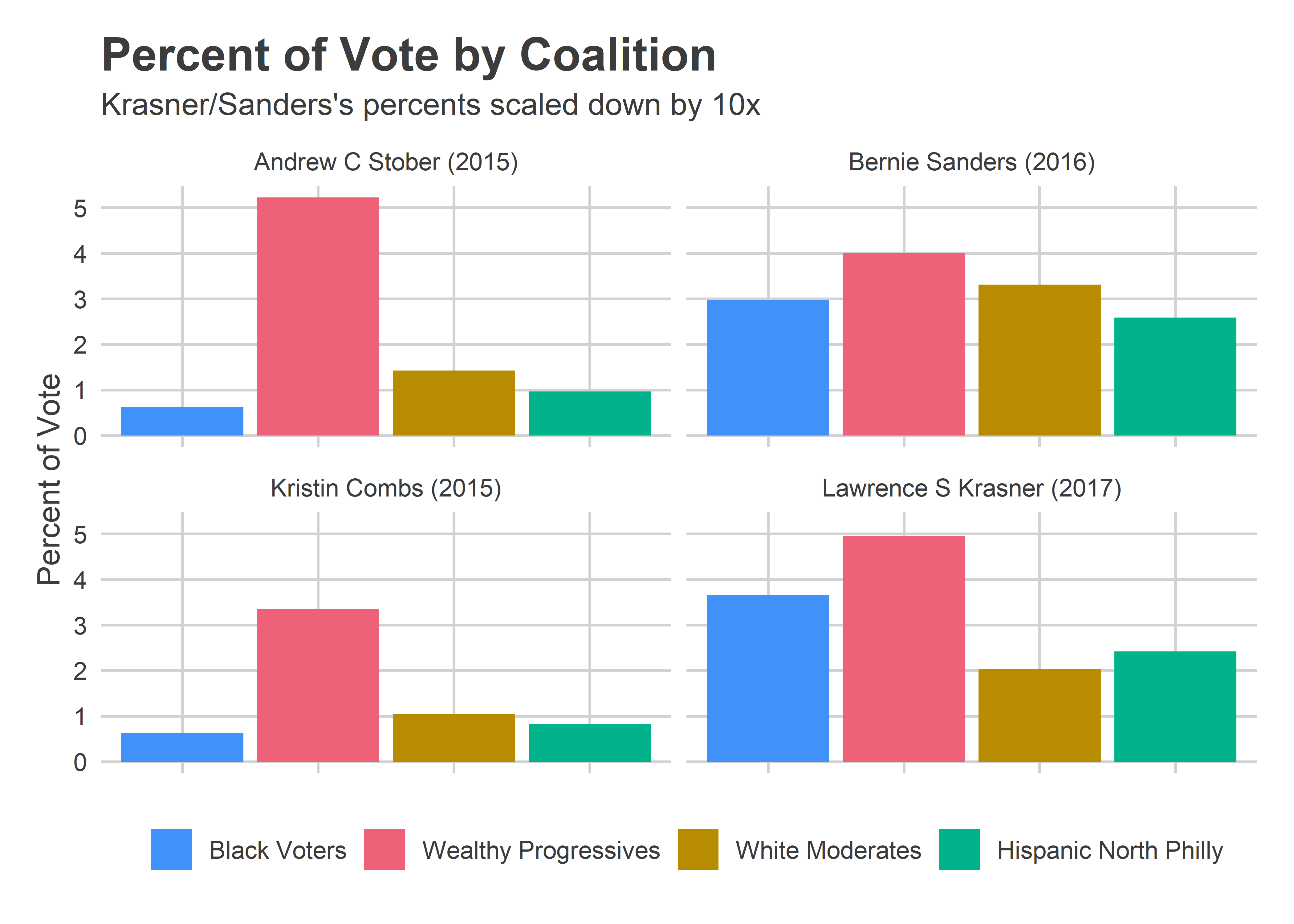
In 2015, third party candidates Stober and Combs were non-entities in Black Wards. Compare that to Sanders and Krasner. Black Wards supported them at nearly 75% the rate that Wealthy Progressive Wards did.
What were the differences between Sanders/Krasner and Stober/Combs? One I can measure, and two I can’t:
- Endorsements from Black Ward leaders. We can measure this: Krasner’s endorsements in the Northwest’s 10 and 50 alone were worth over 800 votes.
What about Brooks’ Inquirer endorsement? The problem for her is that the Inquirer’s endorsement has the biggest effect in exactly the Wealthy Progressive wards where she’s probably already doing best.
Another difference for Sanders and Krasner was the D next to their name. I can’t measure how important this is, but my guess is a lot. Brooks and O’Rourke don’t have it, and they’re all the way at the far end of the ballot.

Krasner and Sanders had significant buzz. They obviously broke through to voters’ awareness. Stober and Combs did not. Brooks is probably somewhere in between, not generating as much awareness as Krasner, but much more than any of 2015’s At Large challengers. That could help break through voters’ reliance on other Party recommendations.
Two of those three things help the Democrats in the Black Wards. And those Wards matter a lot. They represent more than 40% of the city’s votes, well beyond the share of the Wealthy Progressives, which will presumably be Brooks and O’Rourke’s base.
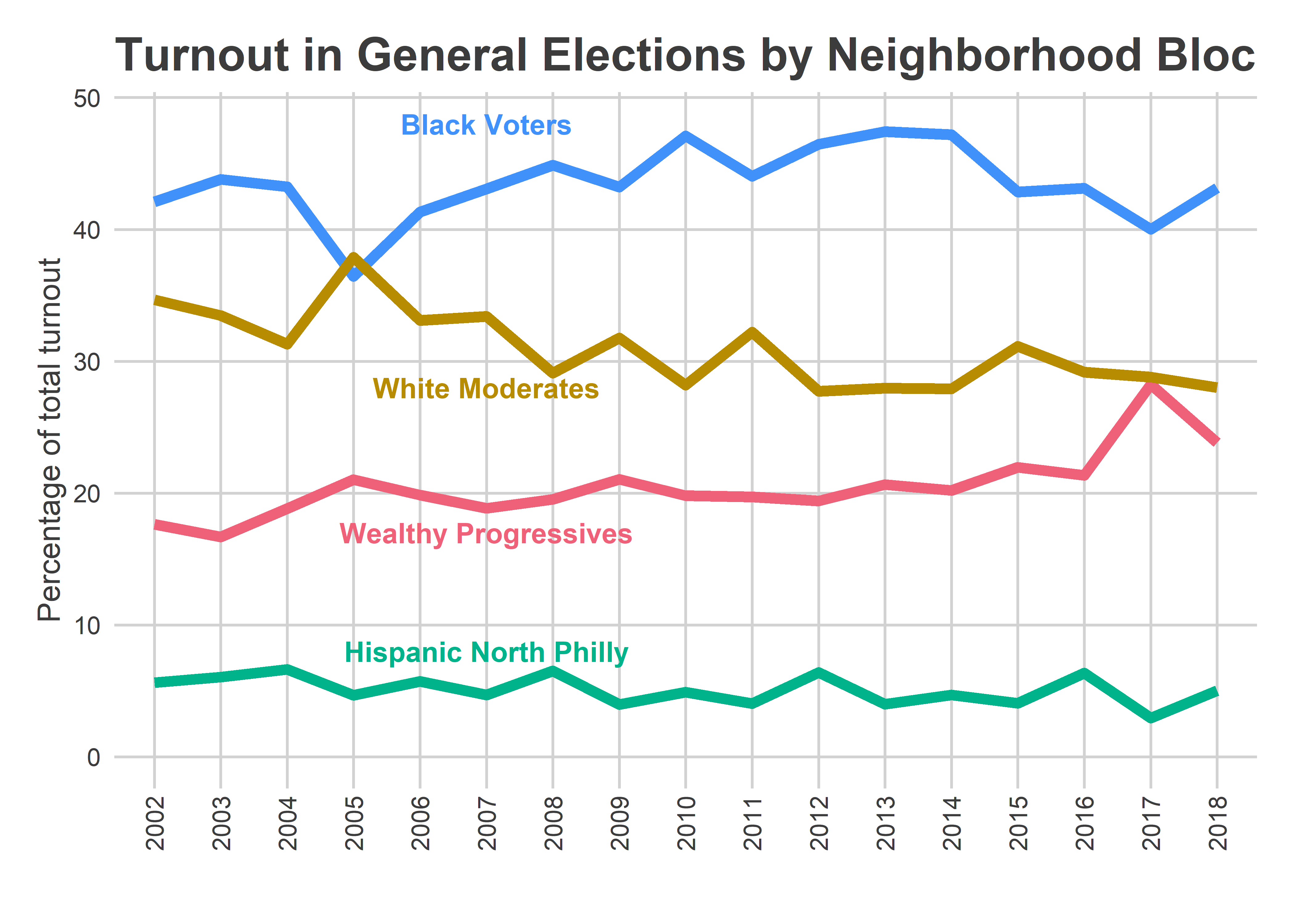
So while you feel like “everyone” is talking about Brooks and O’Rourke, remember that everyone was talking about Bernie, too. And he lost the city.
Conclusion: Could a Democrat lose?
No.
The Democrats have an untouchable margin of victory. Twice as large as a plausible vote count for Brooks.
Even if a Democrat lost to Brooks, they would still win a seat! They need to be beat by three people.
Usually when people think “this time is different,” they’re wrong. Maybe this time is different enough for a third party candidate to beat a Republican. It’s certainly not different enough for a Republican to beat a Democrat.
Why Bullet Voting is probably a bad idea
The answer: Combinatorics.
Different kind of post today. Time for some game theory (or just math? I dunno.)
Commissioner Schmidt tweeted this on Tuesday.
NEW: Bullet votes received by Democratic City Council At-Large candidates in the 2019 Primary Election in Philadelphia. For an explanation of bullet voting: https://t.co/b6IKSMGWC6 CC: @JuliaTerruso @PhillyInquirer pic.twitter.com/LZXWGUKxUT
— Al Schmidt (@Commish_Schmidt) June 25, 2019
It references Bullet Voting, a topic his Office has covered in great detail before. Bullet voting is the act of voting for a single candidate even when you’re allowed to vote for more. A lot of voters do it, either because they think it gives their favorite candidate a better chance to win, or as a cathartic experience. According to another infographic, 19% of Democrats voted for a single At Large candidate on May 21st.
Today, I argue that Bullet Voting is almost always sub-optimal. To make Bullet Voting the right decision, you don’t just need to have a candidate that you love, but a candidate that you love many times more than your second favorite candidates, because you’re hurting your foregone candidates in many more scenarios than you’re helping your favorite one.
Let’s do some math.
Three-Candidate Example
First, consider a simple race.
Suppose there are three candidates for two positions: A , B , and C . A is your favorite, B your second favorite, and C your least.
Write the value you get from two candidates winning as V(A,B) (if e.g. A and B won). Let’s make a simplifying assumption that
V(A,B)=V(A)+V(B) ,
that is, the value of winners is independent of each other, is additive, and the order of their win doesn’t matter. This doesn’t seem too restrictive, but it does mean you don’t have either (a) teams of candidates who are better together than separate, or (b) diminishing returns to candidates, so having two A s really would be twice as good as having one.
The question: Should you vote for both A and B, or bullet vote for A? Assume that in the case of a tie, a coin is flipped for the winner. (I’ll ignore three-way ties).
It helps to frame it as the following: suppose everyone else in the city has voted. You don’t know what the results are, but it’s done. Your choice of bullet voting for A instead of voting for A and B could have the following effects, and only the following effects:
- It could win the election for A if A is losing to B by 1 vote or tied.
- It could lose the election for B if B is losing to C by 1 vote or tied.
That’s it. Bullet voting helps your favorite candidate beat your second tier candidate, but your foregone vote harms your second tier candidate against the third. Importantly, notice that it has no effect on whether A beats C, head-to-head.
This means the expected benefit from bullet voting is
0.5 (V(A)−V(B)) p(C, B>A) − 0.5 (V(B)−V(C)) p(A,C>B)
where the notation p(C, B>A) is the probability that among everyone else’s votes, C is in first, and A is either tied with or one vote behind B . (The 0.5 comes from the coin flip. If there is a 4% chance that A ties B, A would still win half of those, so your vote only increases A‘s win probability by 2%). To interpret the equation above, bullet voting for A increases your value by the value-add of A over B if A is losing to B by one vote, but costs you the value of B over C if B is losing to C by one vote. The choice has no effect in any other ordering. Let’s drop the 0.5, since that multiplies everything, and call the marginal value of the bullet vote:
Marginal Value of Bullet Vote = (V(A)−V(B)) p(C,B>A) − (V(B)−V(C)) p(A,C>B).
You should bullet vote whenever this value is positive.
Consider some cases. (1) If all candidates have equal chances of winning, so that p(C,B>A)=p(A,C>B), then you should bullet vote when V(A)−V(B) > V(B)−V(C), i.e. when the gap in value between A and B is larger than the gap in value between B and C. If you have a strong preference for A, but B and C are interchangeable, then bullet vote for A. But if what really matters is keeping C out of office, then vote for A and B.
(2) If C is a runaway winner, so that p(C,B>A) is much larger than p(A,C>B), then you should bullet vote for A; it’s basically a two-person race.
With more candidates, bullet voting becomes less appealing.
Now, suppose candidate D joins the race. D is somehow even less preferable than C. We will still only have two winners.
Bullet voting for A still only makes a positive difference in the case where A is losing to B by one vote or tied, but foregoing voting for B now hurts you when B is losing to C *or* D by one vote or tied.
In this case, the marginal value of bullet voting is
E[V|Bullet vote for A]−E[V|Vote for both A and B]=
(V(A) − V(B)) (p(C, B>A, D) + p(D, B>A, C))
−(V(B) − V(C)) (p(A, C>B, D) + p(D, C>B, A))
−(V(B) − V(D)) (p(A, D>B, C) + p(C, D>B, A))
This is messy, but it’s basically the difference in value between A and B times the probability that your vote would prove decisive in A beating B, minus the differences in value between B and C, and B and D, times the probabilities your vote would be decisive there. Notice that we don’t need to include cases where A loses to C or D by one vote; your decision to bullet vote or not doesn’t change those head-to-head matchups.
Notice that the value math has completely changed. Now, if all the orderings of candidates are equally probable, the value-add of A over B would need to be twice as large as the value-add of B over C/D because your additional vote for B is decisive in twice as many scenarios as your bullet vote for A . This is the key: the power of the combinatorics means that bullet voting harms your second-favorite candidates in many times more scenarios than it helps your favorite one. And this is why bullet voting is usually a bad idea; it only makes sense if the value-add of your preferred candidate versus your second favorites is many times larger than the value-add of your second favorites versus the rest.
Consider some numbers. Suppose you think candidate A gives you a value of 10, B a value of 4, and C and D are worthless at 0. (The value can represent anything: good to the world, improvement to your life. Whatever you optimize for.) And suppose you think all candidates have equal chances of winning. Should you bullet vote for the candidate you love, A? No. That only helps in the case where A is losing to B by one vote among everyone else, in which case it gives you +6 value. But your foregone vote for B costs you -4 if they lose to C or D, and that is twice as likely to happen: when B loses by a vote to C, and when B loses by a vote to D.
5 slots, 10 candidates
Now let’s consider a situation close to the City Council race on May 21st. Suppose there is a single candidate, A, you love. There are four candidates, B, C, D, and E, who are good. There are five candidates, F, G, H, I, and J, that you dislike. The race actually had more candidates, but suppose only these ten had plausible chances. Let’s further assume that among these candidates, all possible election orderings are equally possible.
Bullet voting for A helps you when B, C, D, or E are beating A by one vote. But it hurts you when any of B, C, D, or E are losing to any of F, G, H, I, or J. Thats 4 scenarios where it helps, but 20 scenarios where it hurts you. Bullet Voting only makes sense if the average gap in your preferences for A vs B/C/D/E is five times larger than the average gap in your preferences for B/C/D/E vs F/G/H/I/J.
You can complicate this by giving each ordering of candidates different probabilities of occuring, but the math of the combinatorics will probably swamp whatever you come up with: the chances that one of your second tier candidates is losing to a third tier candidate will almost always be many times greater than the probability your favorite candidate is losing to a second tier candidate. And Bullet Voting only helps in that second scenario. It only makes sense to bullet vote if the gaps in your preferences are equally disproportionate in the opposite direction.
Note: While I think it’s unlikely that the gap between candidates A and B is five times larger than the gap between B and F, it certainly isn’t impossible. I definitely knew voters in the Primary for whom the value of their personal favorite candidate was five times larger than the gap between their second favorite and sixth; for them, bullet voting was optimal. But it comes at a steep cost.
General Solution
More generally, suppose you are able to vote for K out of C candidates. You have a single favorite candidate, K−1 second favorites, and C−K left over candidates. Let them be ordered, and indexed by i, so i=1 is your favorite and i=C your least favorite. If you bullet vote, you decrease the likelihood that your favorite loses to your second favorites, at the cost of increasing the chances that your second favorites lose to the leftovers.
The value of the Bullet Vote, versus voting for all K, is

where $p_{ji}$ is the probability that among all voters but yourself, candidate j is in Kth place and is tied with i or beating them by a single vote (it’s all of the combinations of P(A>B>…) from above.) I’ve again divided everything by 0.5 for simplicity. Notice that the first summation has K−1 terms, while the second has (K−1)(C−K) terms. If the probabilities are all equal, the average difference in values in the first sum must be C−K times larger than the average difference in values in the second sum for bullet voting to be optimal.
The exact solution for a given race will depend on (a) the gap between your preferred candidate and the others you would vote for, (b) the gap between those others and the candidates you don’t want to win, and (c) the relative probabilities of everyone winning. But the combinatorics will be salient in every scenario.
Example: Third Party Voting
In November’s City Council election, there will be five Democrats, five Republicans, and a number of third party candidates on the ballot for seven At Large spots. Voters can vote for up to five candidates, and the Philadelphia Charter stipulates that no more than five winners can come from the same party. This usually means the five Democrats win in a landslide, and two of the Republicans win. Suppose you wanted to minimize the chance that a Republican would win a seat. What would be the optimal strategy?
Finding one: Bullet Voting doesn’t help. Voters might think Bullet Voting for two third party candidates helps them more than voting for three Democrats and two third party candidates. This isn’t right. Remember that bullet voting only help the candidates you do vote for against the candidates you would have voted for. Here, bullet voting would help the third party candidates if they came within one vote of the Democrat you would vote for. They have the same chance of beating the Republican if you spend a vote on the Democrats or not.
Finding two: Voting for Democrats is also wrong. If you think there is a 100% chance that all the Democrats will win (which there is), then notice that all of their pp s in the sums above are zero: there is no chance that they happen to lose to someone else by a single vote. Thus, it doesn’t help to vote for them.
So it doesn’t help to bullet vote, but it also isn’t optimal to vote for Democrats. What should you do? The best way to beat all the Republicans is to spend all of your votes on third party candidates; this eliminates the chance that you happen to bank on the wrong one, with no effect on the Democrats who are guaranteed to win. If there aren’t enough third party candidates to spend all five of your votes on, you can spend one on your favorite Democrat; it doesn’t make a difference either way (see above).
(Of course, this assumes that you do prefer each of the third party candidates to the Republicans. If you prefer a Republican to a third party candidate, you would have to work out all the summations above to decide if you should vote for that Republican or just withhold a vote.)
So, should you Bullet Vote?
Probably not.